| |

In the modern economy
individuals and businesses pay for products and services using different
forms of payments. These come in the form of a pay now or pay later
method.
Traditional pay now
methods include paper money of that particular government (example, US
Dollar), debit card, check, alterative payment apps, or bank wire
for larger purchases where the money is changed in real time from buyer
to seller.
Traditional pay later methods include credit cards, installments such as
car payments, mortgages, other loans, and lines of credits for personal
and business use from different institutions.
Both methods
are a form of an IOU (I Owe You) because products and services
are being exchanged for a form of US Dollars. Does not
matter the particular bill's ($1, $2, $5, $10, $50, or $100)
or coin's (1, 5, 10, 25, or
50) stored value because the actual money being exchanged
is an IOU to use anywhere else in the economy at a later
time.
 The
US Government writes on all paper money "THIS NOTE IS LEGAL
TENDER FOR ALL DEBTS, PUBLIC AND PRIVATE" which means the
dollar is an IOU of the US government. The
US Government writes on all paper money "THIS NOTE IS LEGAL
TENDER FOR ALL DEBTS, PUBLIC AND PRIVATE" which means the
dollar is an IOU of the US government.
It is not the money itself that
creates the value, because the value of the money is not
backed by any collateral anymore. Before 1971, paper money
was backed by Gold, so the government could only print based
on their Gold reserves at Fort Knox (because paper money
could be convertible into gold). Nowadays, money is
just paper, that when the government wants to print more and
needs more money it can do that at any time. In essence the
only reason that money is worth anything is because all the
people in society accept it's stored value and carry it's
worth in exchange for products and services.
The Fed (also known as Federal
Reserve System) is the central bank of the US comprised of
12 different Federal Reserve Banks around the country, owned
by big private banks and operates relatively independent of
government. The US government when it needs more money in
the economy it borrows money by issuing bonds and then
orders the central bank to buy those bonds by printing
money. This means that every dollar that the government
prints it has to pay interest on that money.

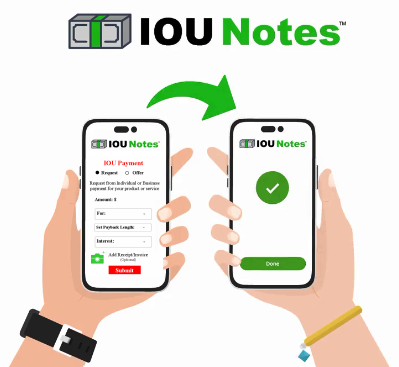 The IOU Notes™
platform focuses on the pay later
method.
The term
IOU (I Owe You) has a history dating to the 18th century. It is often
viewed as an informal written agreement
acknowledging debt.
People have been
providing credit, borrowing, and lending to each other since the
beginning of time. While this concept is not new, IOU Notes created a
platform (patent pending) where transactions can safety and easily take
place, be tracked, etc. in one convenient platform. Every account
created must be a real person or business entity and go through a
verification process by uploading the proper form of identification.
Profiles can be set to public where everyone can see or private mode so
just the individuals and businesses that are working together can see. The IOU Notes™
platform focuses on the pay later
method.
The term
IOU (I Owe You) has a history dating to the 18th century. It is often
viewed as an informal written agreement
acknowledging debt.
People have been
providing credit, borrowing, and lending to each other since the
beginning of time. While this concept is not new, IOU Notes created a
platform (patent pending) where transactions can safety and easily take
place, be tracked, etc. in one convenient platform. Every account
created must be a real person or business entity and go through a
verification process by uploading the proper form of identification.
Profiles can be set to public where everyone can see or private mode so
just the individuals and businesses that are working together can see.
An example
of an IOU in someone's personal life is when a person borrows money from family, friends,
and others in an informal way and writes an IOU (I Owe You) note. It is with the intention to pay back but
a lot of times either people start asking for the money back, or are too
embarrassed to ask, or the person does not pay back and it creates
tensions in the relationship. There are many
situations where individuals need to borrow money to
either pay for immediate expenses (food, rent/mortgage, child expenses,
family expenses, etc.)
Current options to borrow are from banking and lending
institutions who charge high interest rates. Some credit cards offer
zero or low interest rates for a time period but then afterwards
interest rates spike up as much as 29% APR (annual percentage rate) plus
late and other fees. Then there are Payday loan companies that people
use for short tem loans which can add up to over 400% APR or
more when it is finally paid back. These credit cards and
loan companies lure people into their
trap knowing that there will be many people who fall into this interest
trap. Once in debt it is hard to get out. IOU Notes platform interest
rate is set by users (from no interest - 5% max).
An example
of an IOU in the marketplace is as follows. Say ABC Construction Company
places an order for lumber and other building materials and does not
have enough in payment (credit card, cash, check) to pay for the entire
order when it is delivered. Instead, company pays a down payment and
issues an IOU (I Owe You) promising to pay for the rest of the materials
within 30 days with or without interest. Assuming that supplier is ok
with this and has an established business relationship with ABC
Construction Company, an IOU will be accepted by both parties. Many
businesses operate on Net 30 terms which is also a form of IOU's. They
take possession of the product or utilize the service and have 30 days
to pay off the invoice. When an
individual or business starts to try to work with other vendors, that
vendor pulls their credit report to see their history and decides
whether or not to extend credit. Pulling a credit report too often has a
negative effect on that individual or business. This results in making
sense only to ask new vendors for credit on larger types of purchases,
and not small and mid size purchases.
In addition,
many service businesses
in the economy currently extend a form of IOU to their customers while
not even realizing it. There are many types of businesses that operate
this way of providing service a payment is deferred until service is
completed. This happens that same day which might be 15 minutes, 30
minutes, 1 hour, or 2 hours, etc. later when customer leaves from place
of business or service has been provided, depending on the service being
provided. These businesses operate on extending short term IOU to their
customers everyday and are not even aware that it is going on.
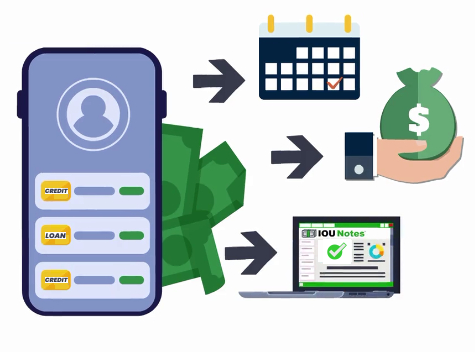 There are hundreds of
service business types and the majority operate on some kind of IOU,
where they provide service first and get paid after service is
completed. A few examples of these types of businesses include sit down
restaurants, bars, hair salons, dentists, auto mechanics/service shops,
home repair services, etc. Most of these businesses provide service
first to the customer and there is no credit check, identification
provided, collateral provided, or many times not even the customer's
basic information (name, address, phone number) is asked for before
service is provided. It has become standard practice in the marketplace
for most service businesses to just provide the service and the customer
will pay immediately afterwards. The IOU Platform takes this already
established practice and extends it for a longer timeframe/pay later
option and also includes this model to product based businesses and
individuals operating as sole proprietorships. There are hundreds of
service business types and the majority operate on some kind of IOU,
where they provide service first and get paid after service is
completed. A few examples of these types of businesses include sit down
restaurants, bars, hair salons, dentists, auto mechanics/service shops,
home repair services, etc. Most of these businesses provide service
first to the customer and there is no credit check, identification
provided, collateral provided, or many times not even the customer's
basic information (name, address, phone number) is asked for before
service is provided. It has become standard practice in the marketplace
for most service businesses to just provide the service and the customer
will pay immediately afterwards. The IOU Platform takes this already
established practice and extends it for a longer timeframe/pay later
option and also includes this model to product based businesses and
individuals operating as sole proprietorships.
Sign Up For
Your FREE Account and
Get Started Now!
|
|
|